



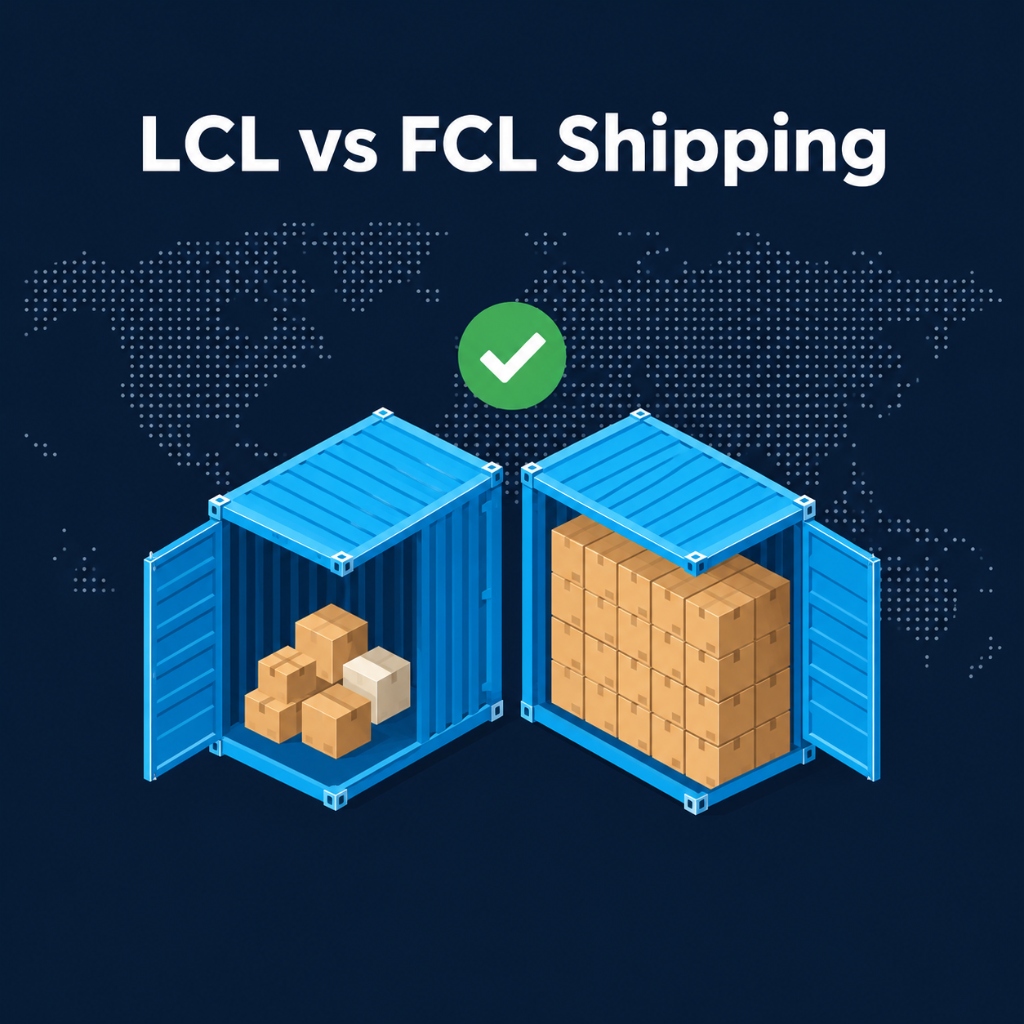
LCL (less than container load) shipping means your cargo shares a container with other shippers' goods and you pay only for the space you use. FCL (full container load) means you book the whole container. LCL is usually cheaper for small volumes, while FCL wins as volume grows or when speed and security matter more.
How LCL Shipping Works
A consolidator, often an FMC-licensed non-vessel-operating common carrier (NVOCC), collects cargo at an origin container freight station (CFS), loads several shippers' goods into one container, and separates them again at the destination CFS (FMC).
FCL vs LCL at a Glance
| Factor | LCL | FCL |
|---|---|---|
| Pricing | Per CBM or weight, plus CFS fees | Flat rate per container |
| Best fit | Small or trial orders | High volumes |
| Transit time | Longer (consolidation steps) | Usually shorter |
| Handling | Handled at both CFS | Loaded and unloaded once |
| Destination fees | CFS storage after free time | Demurrage and detention |
How LCL Shipping Rates Are Calculated
LCL is commonly billed per cubic meter (CBM) or by weight, whichever is greater, with a minimum charge. Add origin and destination CFS fees, documentation, and final delivery, then compare door-to-door totals.
When Does FCL Become Cheaper?
Plug in door-to-door quotes for both options at your actual volume. Above the break-even point, FCL costs less per unit.
Which Should You Choose?
- Choose LCL for small or trial orders and sturdy, palletized cargo.
- Choose FCL near break-even, for fragile or high-value goods, tight deadlines, or reefer and dangerous goods.
- Either way, file the ISF no later than 24 hours before loading (CBP) with an accurate HTS code. With FCL, plan drayage early to avoid demurrage and detention.
How Marinex Supports Ocean Freight
Marinex Logistics is an FMC-certified NVOCC and freight forwarder. Our ocean services cover FCL, LCL, reefer and cold chain, and dangerous goods (IMO) cargo, with reliable lead times, visibility tools, and quick responses. We can quote both options so you can compare door-to-door costs.
People Also Ask
What is the difference between FCL and LCL?
With FCL you book and control the entire container. With LCL you share one, which adds consolidation and deconsolidation steps at CFS warehouses.
Is LCL cheaper than FCL?
For small volumes, usually yes. Calculate your break-even point with real quotes.
Does LCL take longer than FCL?
Usually, because consolidation and deconsolidation add steps at both ends.
Is there a minimum for LCL?
Most consolidators apply a minimum charge, commonly 1 CBM.
Compare FCL and LCL Quotes:
Share your cargo dimensions, weight, and route for a side-by-side quote. See our transportation services or request a quote.